
My ‘Literature of the Middle Passage’ professor Caryl Phillips (Caz) said that “Graham Greene once said that most writers are fully formed by the age of 14.” I’m not sure if Caz understood the relevance of that statement for me personally, and – looking back – I’m not sure how it possibly could have been relevant to any classroom discussions from that semester, but it’s one of the few tidbits of writers’ identity reinforcement that I continue to carry with me into adulthood.
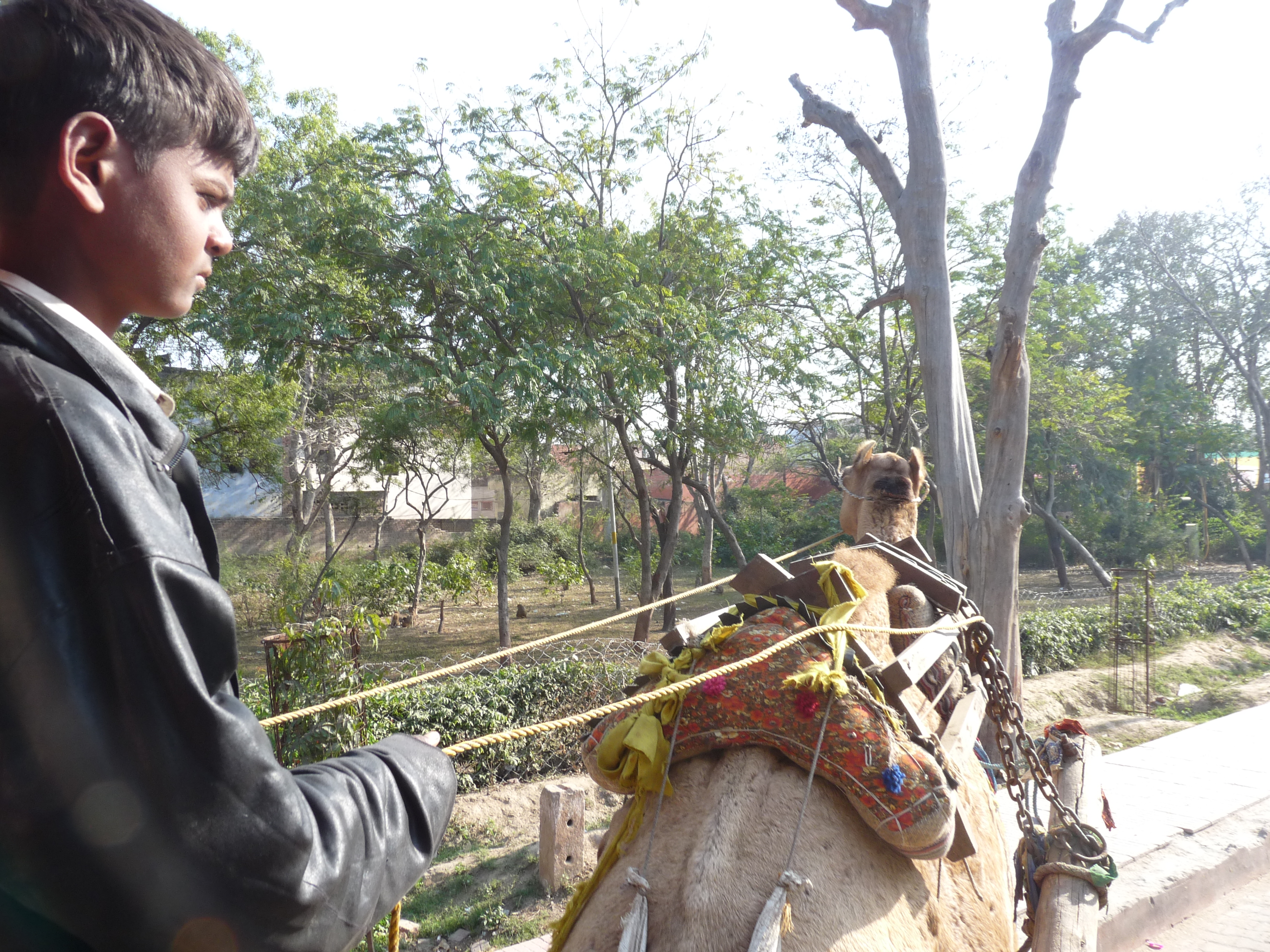
See, our camel driver was fourteen years old and he seemed to be the youngest on the strip from the East street entrance to the East gate of the Taj Mahal. I got the impression that he too was fully formed. He was only 3 years senior to the camel he whipped forward, and both were visibly weather beaten. His is the face of India’s laborers – young, unregulated, untrained, and in service to another person who could be described in the same way. This ten-year old to the eye, fourteen year old by his own admission, triggers images of the boy from Kavi, Latika from Slumdog Millionaire and Sarita, begging for money and food outside Saket mall, who told me she was 4, then 5, but looked 8, and then admitted she didn’t know how old she was.
When I think of a childhood I don’t remember, I have to admit that it’s categorically different from a childhood they never had. While I’ve found many Indian families to be an onion of rules, impositions, superstitions, responsibilities, joint families – my impression of most middle class families is that these layers offer children shelter from the larger unpleasantries experienced by India’s lower class children. For every Amir, there must be a Hassan, who does the grunt work so the former doesn’t have to and who takes the fall because the former wouldn’t know how to get back up.
From my vantage point, this is the way this society is built; often in direct contradiction to a more familiar idea of self-reliance and independence. Surely, India isn’t the only place on earth where this rings true. Needless to say, these layers of family and work order prop up the top echelons of society, and more importantly make it possible for the middle echelons to believe themselves to be on their way to the top. These accepted labor inequities can lead to unconscionable extremes of blatant child labor and abuse; the more common impression I have as a resident outsider is that this methodology leaves gaps of accepted inefficiencies and predatory behaviors that are deeply imbedded in the fabric of this saffron life.
This country has no dearth of young labor. But, what it could use, in my mind, is a more visionary ideal of how best to use it. Carry overs from the caste system may have worked for the British of the 1900s, but they simply don’t translate well in the service & outsourced industries of today’s American standard.
As a child, I learned early that if you want something done right – you have to do it yourself. As an adult, I’m learning that in some stretches of the earth, while the belief rings universal, the division of labor isn’t organized to see its fulfillment. The fact that I have a full-time household staff of three, is absurd to me. The fact that I actually need them at all is even more mind-blowing, especially when I spend more time talking to them about how to appropriately interact with each other than they actually spend doing their jobs.
But, Delhi is built on having layers and layers of unskilled, often young, workers around to do the things you can’t, don’t want or think you shouldn’t have to do. Yesterday, something clicked when I heard tell of how Arjumand Banu Begum come Mumtaz Mahal had 14 children in her 19 years of marriage to Shah Jehan; she died at age 38. The Shah had over 350 concubines who lived in the palace in rooms flanking their marriage bed chamber. When he played parchessi, he used women of the harem as human game pieces. When Mumtaz died giving birth the 14th of their brood, she was remembered as the perfect wife because she traveled behind him wherever he went and had no political aspirations. I hate to be the jerk that can’t translate joy from this love story, but this is relevant to this conversation because it not only shows that being dicked around (pun intended) is par for the course of both work and home, but it also illustrates the historic foundations of the re-fashioning and over-glorifying antiquities’ disregard for human value as a concept of valor to be revered. #offmysoapbox
On the journey to Agra, my Ugandan friend and I discussed for hours how she and her West African sunshine dumpling were going to raise African children of two nations while living in a suburb of the U.S. She frets over identity; I posit that a healthy relationship between parents seals those gaps. She frets over schooling; I suggest home schooling and mixed Montessori education. She worries that they won’t settle comfortably into the title of African-American, when it is what they will be called, but not precisely what they are made of. I found myself reminding her that in the world beyond today, the children we think we’ll own will be born into the world that we make for ourselves.
Lest we forget, though, that their identities will be formed in constant flux and relative to the identities of the children of others, those who we allow to wash our clothes, clean our cars, buy our books, install our cable, DJ on the radio, make millions off of us, do our dirty work, make us go get butterscotch lady finger cookies while walking barefoot across the Brooklyn bridge on stilts, whip a camel so that we don’t have to walk 30 yards. How we treat those around us, whether they work with us, for us, near us, across the seas or not at all, will have a great bearing on the character of the generations to follow.
This week’s lesson from North India is one that has rocked the foundations of my core, causing me to wonder if I can be formed anew to adjust appropriately. Since I don’t want to undo the Caz & Graham mystique, it’s an idea I’ll continue to mull over. Maybe with time, I can disbelieve it. But, I’ll share now for your thoughts. Forgive me my resignation and maybe an offense to the higher being of your choosing, but while we are all God’s children, the meek will not inherit the earth… perhaps the after life but, from where I sit, the selfish opportunists start young and they got the earth on smash for generations and generations to come.

