 Delhi is a city of extremes and contradictions. For me, the issue of giving to the poor, perhaps, is a combination of the two. I have found the begging children, elderly, and disabled to have generated – in me – emotions that are in extreme contradiction to my nature. I admit that I am repulsed, not by the poor, but by the business of being poor. It’s one thing to see “Slumdog Millionaire” and to sigh at how sad those people over there are living. It’s an altogether different thing to see those people every day. Every single day, with their hands outstretched in the same conditions – after you gave them food, after you have seen others give them money. Every single day, those people are on the same street corner, sometimes holding different drugged and drowsy babies each day.
It’s a pathetic scene. It’s sad to hear that most of these people are part of a racket. A racket that pays them a minimal salary of chapati and a few rupees so that they won’t dare starve, but survive to beg another day. The money those of us passersbys fork over goes, instead, to gangs who collude with police to ‘own’ street corners like drug dealers in inner city America. It’s hard to see the value of giving, when there’s such a senseless market of taking.
I can say that I have been deeply affected by this situation. For all the community service I’ve done in my life time, the food banks I’ve donated to, the Salvation Armies I’ve frequented, I have been very reluctant to engage India’s poor. For, while this poverty seems so abject, it also seems so self-induced. While it seems so self-induced, it also seems so inexplicably, dramatically exaggerated in the direction of downtrodden. It is not poverty that causes children to beg in the streets for a pittance, when government schools are free. It is not poverty that causes women to re-open gash marks on their bodies to produce more gore with which to guilt givers. The poverty itself is not pretend, but these theatrical advances are all too frequent and all too irresponsible on the part of the actor. The whole scene has turned me off.
Delhi has left me with a bitter and miserly taste. I find myself despising street children, because I know it’s just a matter of time before they come begging and whining incessantly for something I will never give – money. They’ll touch you. They’ll poke you. They’ll touch your feet as a sign of respect and also as a nuisance – hoping that you’ll be so annoyed that you’ll give them money to go away. And, I must admit, I do want them to go away. Not because I don’t want their poverty in my face, but simply because I know there’s nothing I can do to help them. Their extremes can’t be helped by money, and this sick theatre won’t be abolished by my guilt. Yet, as I am gearing up to leave a city that has – despite all my complaints – allowed me to make significant progress personally and professionally, I have decided that I will learn to trust.
Finding a charity that one can trust in Delhi is like differentiating melted chocolate from fresh cow dung – not using your sense of smell. It’s a dirty and involved business. It requires research and personal investment. Or else the consequences are grave. Word has it that there are over 3 million non-governmental organizations (NGOs) in India, hundreds of thousands of which are New Delhi based. Corruption is commonplace and an ever-present crime of opportunity. Yet, in my quest to accomplish #24 of my 30 before 30, I found 3 charities that I’m willing to support.
While at a work organized volunteer day I finally got a chance to engage with the children of Salaam Balaak Trust. I’d heard for years that these street children gave city tours (dare I say, slum tours), but I never could actually find time in my schedule to go on one. Over an art project with children of all ages, I came to find out that the organization takes in children who are found in and around Delhi’s train station. Many are runaways who left abuse, prostitution, and/or child labor in their local villages and towns. Also, they work to serve children who are not orphaned, but whose parents are otherwise slum residents or homeless. So, this art project outing rekindled my interest in the organization and has compelled me to again revisit the sore subject of street children.












While browsing the web for some academic research I was working on, I came across Deepalaya – a non-religious, NGO focused on eradicating urban and rural poverty. With options to sponsor a child or support specific projects of health, sheltering, or girls’ education, it seems this almost thirty year old organization is doing good work. My contact with this organization is new and, for lack of time, mainly financial. Yet, I suspect it will be sustained. As the communication between the organization and sponsors is really detailed and steady – understand that this is not usually the case with other organizations I’ve been in touch with – I can believe that I will continue to build confidence in the organization and a relationship with the child I sponsor.
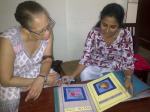
 Kamalini came to me in the mail. I received an ad about a women’s vocational school that was not only accepting volunteers, but also in-kind donations of any kind. I had long grown tired of donating my old clothes to the same organization and wanted to build a relationship with a new organization. I found the organizers at Kamalini to be a dedicated and concentrated group of both foreign and Indian women working together to provide vocational skills to women in urban villages in and around Delhi. While some chose to use these educational opportunities to get better at their professions, others were just starting out and seeking the financial independence needed for traditional Indian women to make tough personal choices. Kamalini has teamed up with a local tour guide to give a guided tour of the Shahpur Jat Village neighborhood and then a tour of the Kamalini facility. See below photos of my tour, which has effectively changed my relationship with this city and my feelings about philanthropy.














 existabovethenoise